Cross cutting themes are incorporated into teaching with a focus on multicultural perspectives and appropriate use of technology.
I see mathematics as "cross cutting" when a single mathematical concept can solve a variety of problems. For example, in our Algebra 2 unit on modeling with quadratic equations, we used parabolas to model the path of an object dropped off a building, the temperature over the course of a day, and the fuel efficiency of a vehicle, as well as the skyrocketing price of the EpiPen. We used all of our knowledge about quadratic equations and applied it to a variety of situations. This is an opportune way to incorporate multicultural perspectives. By solving multiple types of problems and encouraging multiple ways of thinking about the same problem (see Claim IV), I was able to foster potentially multicultural ways of thinking about math. However, I struggled to explicitly incorporate multicultural perspectives. I do not think I ever discouraged multicultural perspectives, but I did not necessarily recognize the existence of multicultural perspectives. Partly because I am not familiar with many multicultural perspectives on mathematics, and partly because my students and I are so accustomed to a Euro-centric, base-10 number system, I believe this could be an area for improvement for teaching. Much of the math we use today is the result of European mathematicians, but the contributions of other mathematicians could have taken a larger role in my teaching.
Technology Use
 Technology use, on the other hand, strongly contributed to my ability to incorporate cross cutting themes. For example, the TI-84 graphing calculator provided opportunities to explore problems at a deeper level than we could with just pen and pencil. The calculator allowed us to generate equations for the price of the EpiPen and allowed us to quickly see a scatter plot of the price of common foods versus their calories per serving. The calculator also served as an important tool for all students to check their work, and helped visual learners see graphs of equations. I also used the Grapher application for Mac to show students more complex graphs. For example, in Algebra 2 we solved systems of linear equations with three variables. I was able to use Grapher to show students the three dimensional graphs that the equations generate. In Intro to Calculus, we discussed the basic equation of a circle. Using Grapher I was able to easily show students how small changes to the equation of a circle could result in an ellipse or a hyperbola, deepening their understanding of why the equation of a circle looks the way it does. For assessments, I also took advantage of Kahoot, which I discuss in Claim VI.
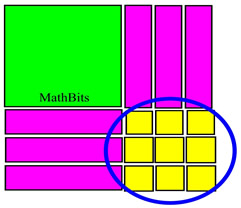 Technology does not have to be electronic. I see any tool I can use to do math without only a pencil and paper to be a use of technology. I took advantage of manipulatives to represent mathematical concepts. In Algebra 2 we used "Algeblocks" to represent the terms of a quadratic equation and help us understand the concepts behind completing the square. Students were able to literally able to complete a square with their Algeblocks, gaining conceptual understanding of completing the square beyond memorizing an algebraic process. This deep understanding allowed us to focus on the multiple real-world applications for completing the square.
Images courtesy of Texas Insturments, mathbitsnotebook.com

 Please wait...
 Overview