Students are reflective practitioners who create and manage effective learning environments informed by their solid understanding of educational research.
Through periodic "theoretical logs," I was able to formally reflect on my experiences in the classroom, but I found myself reflecting on my teaching practices informally on a daily basis. I would question whether my teaching was effective for understanding the mathematical concept, incorporating student voices, and supporting all learners. My ongoing reflection is informed by educational research, some of which discusses teaching at a sociological level, while other bodies of work focus specifically on daily classroom practices.
 The singular work that most informs my teaching is Friere's Pedagogy of the Oppressed (1968) in which Friere describes the banking model of education, in which an all-knowing teacher deposits knowledge in to the heads of the passive students. Friere encouraged teachers to work against this model, which I try to do daily, especially in a discipline known for long lectures and quiet students. I try to make my lessons interactive, asking frequent questions and asking students for their opinions on how to solve problems. I incorporate group work at least a few times each week and encourage students to learn from each other. Borrowing from the idea of Constructivist education (Brooks and Brooks, 1993), I try to have students discover mathematical concepts with limited teacher assistance. For example, when covering the Remainder Theorem (which states that the remainder after synthetic division provides the value of the function evaluated at the divisor) I had students complete a few synthetic division problems as well as evaluate functions by plugging in values. Students then began to notice that the remainder of synthetic division and the function values were the same. All I had to do was give it a name: The Remainder Theorem, without any more top-down lecturing.
My teaching is also informed by theory on teaching practices. For example Brookfield (2015) suggests getting used to awkward silences with "extended waiting time" after answering questions, something I have struggled with but seek to improve. Kilpatrick et. al. (2001) discuss mathematical proficiency and state that conceptual understanding of math comes with being able to represent concepts in multiple ways. Therefore I try to show multiple ways to solve problems. For example, we can solve a polynomial using factoring, long division, synthetic division and various functions with the graphing calculator. In Intro to Calculus, students completed an activity where they derived the distance formula using the Pythagorean theorem, and were then able to derive the equation of a circle, seeing how all three formulas are related, and also constructing their own knowledge.
Math Anxiety
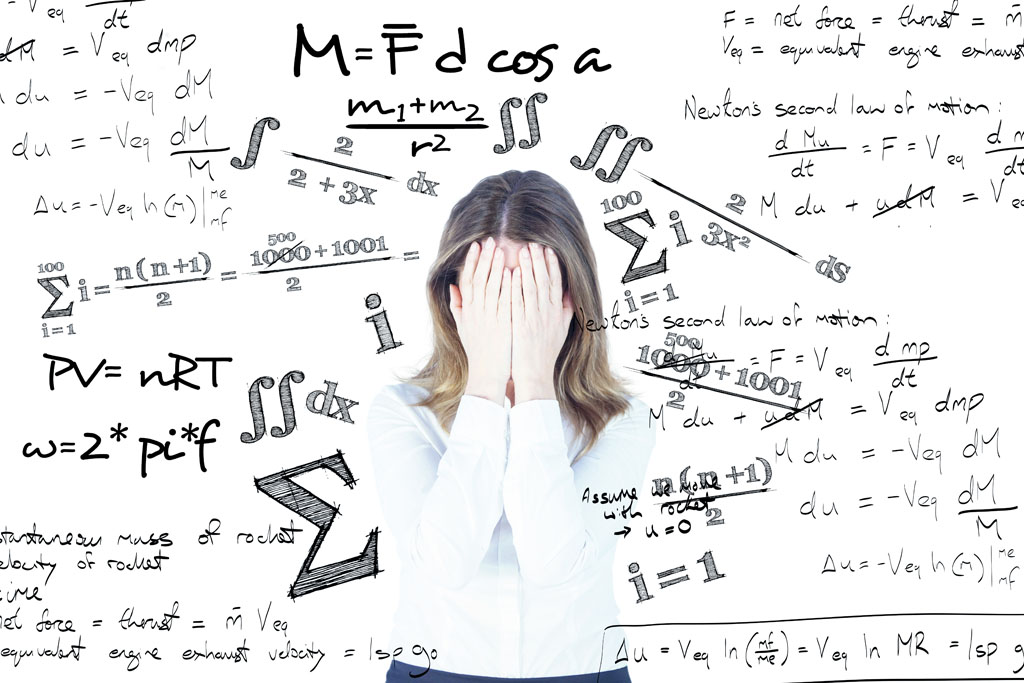 Whenever I tell someone I'm studying to be a math teacher, they often respond, "Good for you. Math was my worst subject." So many people have terrible memories of math and remember math class as a stressful, unpleasant experience. This is, in part, math anxiety, which I try to avoid in my teaching. At the most basic level, I try to get students to not hate math, and ideally I get them to appreciate math and see it as useful and not so intimidating. Greenwood (1984) states that math anxiety stems not from the curriculum itself, but from the way mathematical information is presented. At the suggestion of Alper et. al. (1997), I try to create environments that encourage unique solution methods and create lessons where all students can experience success. For example, in an activity in which we represented the process of completing the square with Algeblocks, some students who typically struggle with math found success because they did not need any background mathematical knowledge. Overall, I see my biggest mission as a math teacher to be reducing math anxiety.
Alper, L., Fendel, D., Fraser, S., & Resek, D. (1997). Designing a high school mathematics curriculum for all students. American Journal of Education, 106(1), 148-178.
Brookfield, S. D. (2015). The skillful teacher: On technique, trust, and responsiveness in the classroom. John Wiley & Sons.
Brooks, J. G., & Brooks, M. G. (1993). In Search of Understanding: The Case for Constructivist Classrooms. Alexandria, VA: Association for Supervision and Curriculum Development.
Freire (1968). Pedagogy of the Oppressed. Harmondsworth: Penguin Books.
Greenwood, J. (1984). Soundoff: My Anxieties about Math Anxiety. Mathematics teacher, 77(9), 662-63.
Kilpatrick, J., Swafford, J., & Findell, B. (2001). The strands of mathematical proficiency. Adding it up: Helping children learn mathematics, 115-118.
Images courtesy of Wikipedia, med.stanford.edu

 Please wait...
 Overview