Students are committed to a critical evaluation of how white supremacy, cis heteropatriarchy, colonialism, ableism, and capitalism intersect to legitimate violence, knowledge, and power.
At first, bringing social justice in to my math classes seemed intimidating. I asked myself, "How can I possibly find time to cover all of the math curriculum and talk about social justice?" I saw math and social justice as disjoint and at times in oppositions with each other. Over time I found that social justice topics may not naturally find their way in to math, but there are ways to simultaneously teach math curriculum and explore injustice. I did this in my class in two ways: by directly incorporating social justice topics in to the curriculum, and by using social justice as a stance/teaching philosophy, informing how I teach a subject that has been historically dominated by white males.
Incorporating Social Justice in to the Curriculum
I found that the most opportune times to introduce social justice topics are when students are working with data. 
This is not reserved for statistics classes. In my Algebra 2 classes, students were learning how to take a set of data and find a quadratic regression (parabola of best fit) using their graphing calculator. Instead of using the relatively meaningless data set provided by the textbook, I went online and found data about the skyrocketing price of the EpiPen which students then graphed and analyzed, leading to a discussion that encompassed both quadratic equations and questioned the capitalism and power dynamics that has made this life-saving drug unaffordable for some of those who need it most.
My biggest fear throughout the semester was that I would run out of time to teach a very dense common core curriculum and would have to sacrifice any discussion of social justice to save time. This activity, however, took the same amount of time as any other activity exploring quadratic regressions, yet was much more meaningful. The EpiPen activity asked students to find a quadratic model for the data and think about why the price of an essential drug was able to skyrocket. Who has the power to decide drug prices? Who suffers the most? Many students could also relate to this activity, as they may use an EpiPen themselves and, in a school district with a high poverty rate, many students are familiar with expensive drug prices.
I was also able to do a similar activity with students when we were studying linear regressions. I gave students a data set comparing the prices of some common foods and the number of calories per serving. Students graphed the data and found a linear model for the data to see if healthier food truly is more expensive. Most students concluded that, given the data provided, they could not come to any absolute conclusions, but we discussed shortfalls in the data. For example, calories are not the only way to measure the nutritional value of food. This allowed students to think about inequality in access to healthy food, as well as become more critical data analysts, realizing that sometimes we need more information before we can draw conclusions.
 Occasionally I found that there were topics I wanted to discuss that strayed away from the curriculum. While I couldn't do this often, my Intro to Calculus class had a free day in October, allowing us to discuss something that everyone was already talking about: the election. We explored a common complaint about the 2016 election ("We have to choose between these two?") by looking at some mathematical voting theories. When we vote, why do we place a single vote for our favorite candidate? What if you could rank candidates, or place multiple votes? There are many voting theories that use rankings and weighting to determine who wins the election (see http://www.ctl.ua.edu/math103/voting/voting.htm#Voting%20Methods for more information). We discussed how such a voting system could disempower the two party system and give citizens more power when they vote. While this did not relate directly to the course curriculum, it was not a departure from math, as these voting systems are mathematically informed and require analyzing permutations of candidates.
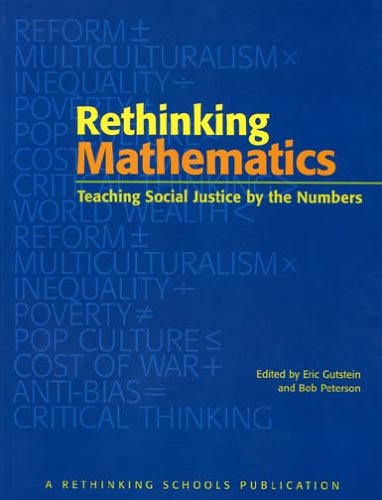
These were a few of the most successful examples of direct insertion of social justice topics in to the curriculum, but mathematics can be used to analyze patterns of segregation, housing prices, and much more. The book Rethinking Mathematics: Teaching Social Justice by the Numbers provides many more examples of teaching math for social justice.
Black, P. & Wiliam, D. (2001) Inside the black box: Raising standards through classroom assessment. Retrieved from http://weaeducation.typepad.co.uk/files/blackbox-1.pdf

 Please wait...
 Overview