<center><font size=5>Rachel Beach's Education Portfolio

Home > Course Work > Cultural Diversity > Speakers and Videos

Speakers and Videos

film-camera-clipart-0704-1a_tn.jpg

Throughout my Cultural Diversity in Education class, we have watched and listened to several inspirational videos and speakers, all of whom have challenged the way I used to view the world.   The following videos and speakers have motivated me to become more accepting and appreciative of differences.  


Graphic citation: www.aero-news.net/


<MARQUEE behavior=alternate>Motivational Speakers and Videos!</MARQUEE>

Stand and Deliver

StandandDeliverBWCrop.jpg

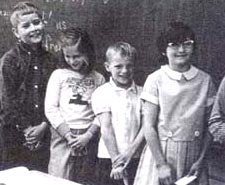
With the help of a teacher, a class expected to fail or meet standards of a school exceeds beyond what anyone imagined in the video, Stand and Deliver.   Mr. Escalante’s math students prove that with the right instruction and faith from a teacher, students can reach and exceed expectations placed on them, whether they are a female, a rebel, a Hispanic, or an intelligent child with other expectations from family members.  Mr. Escalante was originally supposed to teach computer classes at the school, but because the school lacked the resources to buy computers, he began teaching math classes with students who had barely attained a seventh grade education.  The students were difficult at first and when he asked one rebellious, trouble-making student a question, he refused to answer.  Mr. Escalante then said, “Oh, tough guy.”  “Tough guys don’t know math, they flip burgers for a living.”  I thought this was a witty and great way to inform a teenager what direction he was heading in by hiding his intelligence and interest for school in order to be “cool” and accepted.  This rebellious student finally answered his math problem correctly and appeared surprised and unsure of the outcome of sharing his intelligence with the class.  After seeing significant improvement in his students, Mr. Escalante proposed teaching a calculus class to the school staff.  The staff appeared shocked at his suggestion and did not believe he would succeed.  They told him that they were all doing what they could and had been trying their best.  Mr. Escalante looks around and says, “I’m not, I could do more.”  After a little bantering back and forth, they decided to give Mr. Escalante a chance.  He later became absorbed and consumed with the success of his students, so much that his family became a little neglected.  Mr. Escalante soon decided to take his class another step forward, and had them take the AP Calculus test in which all 18 of them passed.  However, all students received letters insinuating that the entire class cheated because all of them missed 3-4 questions and finished in about the same amount of time.  After nights of fighting and studying, Mr. Escalante decided to have his students retake the test, and again, they passed with flying colors.  Every class Mr. Escalante taught after this particular year took this test and the majority of them passed as well. 

  • When Mr. Escalante told the rebellious student, “Tough guys don’t know math, they flip burgers for a living,” I believe that might have affected that student’s perspective.  He became one of the 18 students that took and passed the AP Calculus test.  I believe Mr. Escalante’s faith, teaching skills, and this comment truly made a difference in this student’s life.  It is amazing what one statement and the knowledge that a teacher believes in you, can do for a student.  When I am a teacher I will aspire to be as motivational as Mr. Escalante.  I will have faith in my students even when everyone around me does not believe they can accomplish something.  It is so important to believe in students and I will always try to believe in and motivate every student that walks into my classroom.
  • When Mr. Escalante’s staff and department chair said that they were doing all they could; it is understandable that they would feel that way.  They are used to the amount of success the students show, and they more than likely were trying.  However, Mr. Escalante proved to them by saying “I could do more,” That they probably were not in fact doing everything they could possibly do to make the students more successful.  He then showed them one way that he could do better: making students feel encouraged, believed in, smart, and expecting more from them.  I hope to always be expecting more from my students than they believe they can accomplish.  I believe that if students feel someone believes in them, their confidence and success will sky-rocket. I also want to remember what Mr. Escalante told his staff, “I could do more.”  Once I feel like I have done enough motivating my students and there is nothing else I can do, that is the quote I want to jump into my thoughts so that I will be motivated to help students more.
  • When the students were questioned about whether they cheated or not on the AP test, they felt a loss of hope, as if all their hard work was in vain.  At this point Mr. Escalante could have given up and said “Well we tried!”  But he instead kept on believing and pushing them, and had them study with him the night before the next test.  When the students passed the second time, it was most likely more rewarding that the first because they got another taste of true confidence in their abilities, thanks in large part to Mr. Escalante, the teacher who wouldn’t give up!  I hope to be a teacher that pushes my students even when they feel their efforts have been in vain and no one believes in them.  I hope to be a teacher like Mr. Escalante, one who doesn’t give up!

Graphic citation: www.collegenowlive.com/<WBR>FILM_FESTIVAL/standdel.htm

Race and Privilege Panel

Panel%20discussion%20pic.jpg

“Color is not a representation of your character.” (David Munoz) While several of us would read this quote and agree, is this proven true in society?  Do some people have privilege and acceptance over others?  Do people continue to judge others by the color of their skin?  If your answer is something along the lines of “no, that doesn’t happen anymore,”  I would have to disagree with you.  The activity that led into the race and privilege panel discussion was very similar to the activity used in “A Class Divided,”  a video in which a teacher puts her white-American students directly in the shoes of (in her example,) African-Americans.  As the audience, we were given a strip of color, (blue, green and orange.)  We were told to go around the room, meet people, and exchange strips of paper.  In the middle of our conversations we were told, “by the way blue people, you are the best color, green, you’re alright and orange, not so good, now go meet more people.”  Obviously the orange people found themselves having a more difficult time meeting others this time.  After a few more rounds of introducing ourselves to others with these labels in mind, we took a seat and were told what having privilege really means.  Privilege is having easier access to a more comfortable life.  Some examples of privileged people are: white people, males, and people with straight sexual orientation.  The panel included a historian (Dr. Petrequin,) a religion and philosophy instructor (Dr. Munoz,) and a psychology instructor (Dr. Ramos.)  Each of them had interesting and insightful views on privilege and how it came about and exists.  Dr. Petrequin provided some concrete examples on how white privilege has been created such as, the Manifest Destiny, the cruelty American Indians were put through in America, slavery and auctions of slaves, and he even mentioned a little known fact that Hawaiians have suffered in the past as well.  Dr. Munoz shared some of his personal history as to what he has seen in America.  Dr. Munoz was born in Mexico city and when he moved here he was very excited, he believed America was the Utopia, the place where everyone was accepted.  He admitted that America is getting better as far as racism goes, but that when he moved here he was disappointed to find that white males were often shown more respect and were not followed in stores as often as he was.  One day he asked himself why, and while there are so many reasons, none of them right, he did share three philosophical principles that should help heal discrimination.  The principles were, to avoid judging by appearances, learn to validate differences and give others dignity, and my personal favorite, make an effort to learn something new.  Dr. Munoz made a very good point that tied into the last principle, “people who are different can teach you something.”  Dr. Ramos had us do another activity asking us to close our eyes and picture a doctor and dentist.  She then asked us to raise our hands if any of us pictured African-American doctors or dentists and only a few people raised their hands.  Dr. Ramos then told us that “what we see is what’s been constructed for us.”  Dr. Ramos told us that America has changed behavior with racism, but not necessarily attitudes.  An example she provided was slavery.  When slavery was abolished, hateful attitudes and segregation continued to exist.  This example was one of several she provided.  Dr. Ramos said that people sometimes feel they need to apologize for the past and they don’t.  If we could all just learn about diversity and reflect on the privileges, “eventually you’ll come to build up what you understand.”  Dr. Ramos also concluded that we are making progress when we become interested in cultures and diversity, and I personally believe she is right.

  • I believe I will remember this panel for a long time.  It was very insightful to hear teachers from different cultures who are familiar with privilege, voice what they have learned about it.  Having said that, I now have another reason to consider having speakers from different cultures come and speak to my class when I am a teacher.
  •  I enjoyed listening to everyone in the panel but Dr. Munoz was the most interesting speaker to me.  I believe part of the reason was a specific thing he said, “People who are different can teach you something.”  I want to write this quote on a poster and tape it on the wall of my classroom one day!  I believe this is a very important thing for people to learn, especially at a young age so that they learn to truly appreciate differences early in life.  Of course a quote won’t be the one thing that accomplishes this goal, but it will be a good quote for them to look at everyday.
  • I also believe the activity of closing your eyes and imagining a doctor/dentist could possibly be a good activity for the classroom.  It could be a good way to address and change one of the prime examples of white/male privilege.  After asking students to do this activity, a teacher could then address the student’s answers, “what did you see?”  “Why do you think you saw a white man?” (If they did.)  The next thing to address might be “how can we change this thinking?”  This is a small way to get the ball rolling on understanding why these privileges happen, and learning to change expectations of all students and what they can do at a young age.

Graphic citation: class collection

A Class Divided

aclassdivided.jpg

“Blue eyed people are better than brown-eyed people.”  After reading this statement, one might believe it was a joke, but what if it wasn’t?  What if Caucasians had to directly experience the type of treatment they once bestowed upon African-Americans?  After observing a Caucasian, adult male condescend to an African-American on the news the day after Martin Luther King died, a third grade teacher, Mrs. Elliot, decided she would teach her students a lesson they would never forget.  She started the lecture by asking the children if white people treated black people differently, and in what specific ways they did.  She then began her experiment by saying, “Blue eyed people are smarter than brown eyed people,” and tied collars around the brown eyed children’s necks.  After disagreeing for a short period of time, and then giving up, the brown eyed children began to look depressed.  At recess, the children were separated from each other, a fight broke out, and one child even commented, “It’s like our best friends were being taken away from us.”  The blue eyed children began to tease and taunt the brown eyed children, and when asked why, they couldn’t come up with an explanation.  Mrs. Elliot realized that within 15 minutes she had seen thoughtful children begin to discriminate and become evil.  She then switched the experiment, making the brown eyed children the ideal race.  One student said he felt like “a dog on a leash.”  With a powerful statement such as that, it is clear why every time this experiment was performed, students grades excelled the day in which they were on top, and declined the day that they were the “dog on a leash.”  After the experiment was over, Mrs. Elliot confessed that the things she had said were false and asked them questions about whether color, or differences are reasons to treat someone badly.  The children said no and with complete excitement threw their collars away and hugged their blue and brown eyed friends.  Fourteen years later, Mrs. Elliot and her third grade class had a reunion in which they talked about the events of that day.  They explained their emotions and reactions and confirmed that the lesson was worth the agony of that day because it made them better, more accepting people, even in their own homes.


  • When Mrs. Elliot explained how her students’ grades and performance soared and dropped during the course of a couple days, I realized how important it is for every child to feel accepted and just as likely to succeed as the white or black child who sits next to them in class.  It is also obvious how much an authority’s opinion matters and affects a young child and what they will be like in the future.  When I have a classroom of my own, I want to make ever student feel they can succeed.
  • One student in the video said he “felt like a dog on a leash.”  This statement made me think about how sad it is that any child would ever feel that way and there is no reason any child ever should.  When I am a teacher I will try to make the class feel like a community so that no one in that classroom ever makes them feel insecure, unintelligent, or like a “dog on a leash.”
  • Fourteen years later, all the students in Mrs. Elliot’s third grade class explained how they remembered the emotions and the turmoil of that day when they learned what it was like to be discriminated against, and decided to never be a part of discrimination.  Two days in third grade changed these individuals forever.  I hope to be a teacher who can teach my students a lesson such as this; one that encourages them to be a better person for the remainder of their life.

Graphic citation: http://www.newsreel.org/site_images/aclassdi.jpg

Aurelia Camacho

Camacho3.jpg

“Your success is not just your own,”  Mrs. Camacho declared after sharing her impressive, motivational story of her success.  Mrs. Camacho’s life was one challenge after another, but she reached her dream after years of trying.  She was born in Mexico, but has lived in American since she was eight years old.  She had 8 siblings and due to poor health and poverty only five survived.  Her mother and father had serious problems in their marriage and one day her mother decided she could not live like she was anymore so she packed the children’s belongings in a hope chest and left with them.  As a child, Mrs. Camacho saw her mother on weekends because her mother was trying to raise money to pay for her children to become citizens.  It is often a very tedious process to become a citizen, but a man whom Mrs. Camacho’s family knew made their process go quickly and smoothly.  When Mrs. Camacho started school she learned that she was very good at spelling due to her memory, but she was unaware of what she was spelling.  Because there were no ESL (English as a Second Language)/Bilingual programs when Mrs. Camacho was a child, she was placed in special education for a few years.  Although this program is not ideal for children learning a new language, Mrs. Camacho said it helped her.  After watching her mother work in the fields Mrs. Camacho decided she never wanted to do that, and that her dream was to be a bilingual secretary.  Mrs. Camacho’s challenge to reach her dream became more of an obstacle when she got married.  Her husband did not want her to work, she had a child, and they began to have problems.  After being divorced, bedridden and tempted to quit school, Mrs. Camacho gained help from professors to accommodate her needs so she would still be able to reach her dreams.  Her dream had now turned into becoming a bilingual teacher and after the help of professors and becoming one of the top 10 student teachers of the year at Arizona State University, she reached her dream.  Mrs. Camacho has taught all grades, has been an ESL coordinator, and has achieved her Masters Degree.  Mrs. Camacho admitted that is was definitely a benefit to be bilingual because when it was difficult to teach students, she could clear things up with them as well as communicate with their parents.  Although many people think bilingual education differs greatly from ESL programs, Mrs. Camacho admits that they are similar because “In order to succeed you need to have strength in English,” However, she admits, “I use Spanish if necessary.”  She considers herself an ESL teacher because she focuses on English, but the fact that she’s bilingual is definitely a benefit for her and her students.  It was motivational and interesting to hear about Mrs. Camacho’s challenging journey.  Her story proves “your success is not just your own,” because she struggled her entire life and still managed to reach her dream, even as a student who came into America knowing no English: a challenge many migrant students have and will continue to have.

  • Mrs. Camacho’s story was impressive, I will consider sharing it with students who are struggling because I realize students with these types of challenges will come into my classroom, especially if I end up teaching at an ESL instruction school.
  • I liked that Mrs. Camacho shared that although her culture is important to her and she is not abandoning it, students migrating to the US need to learn English.  There is so much debate as to which way is the best way to teach students English, and Mrs. Camacho positively promoted what I thought might be the best way.  I was glad to hear that the English as a Second Language program I have gained some confidence in can be effective.  I hope to teach in an ESL classroom one day, and although I think it is a good program, I am now considering learning Spanish.  I believe this would be a challenge, but because of Mrs. Camacho’s story, I find myself wanting to learn Spanish.  She was able to help her students on a level I cannot, because she can speak to their parents and help the children when communication becomes confusing.
  • I always admire those who achieve their dreams despite their challenging struggles.  Sometimes it is easier to give up and consider yourself a failure than to keep challenging yourself, but Mrs. Camacho never gave up.  She started to once, and professors stepped in.  I want to be a teacher like the professors who helped Mrs. Camacho because they gave her more time and accommodations during college because of her unique struggles.  Children need special help and more time when they are dealing with difficult problems, and it is important to give them these things in order for them to succeed.

Graphic citation: class collection

Janel White-Taylor

Janel%201.jpg

What is it like to be an African American in <st1:State w:st="on"><st1:place w:st="on">Arizona</st1:place></st1:State>?  “Well, just look in this class, it’s like this almost everywhere I go in <st1:State w:st="on"><st1:place w:st="on">Arizona</st1:place></st1:State>.”  While Dr. Janel White Taylor was in no way complaining that our class has no African-American students in it, she admitted that it is something she notices.  The self-proclaimed boisterous (not to mention entertaining) Dr. Janel White Taylor shared many stories with our classroom about her past experiences visiting the South.  She told us that living in <st1:State w:st="on"><st1:place w:st="on">Arizona</st1:place></st1:State> allowed her to be more boisterous but that it got her in trouble down south when she was visiting relatives.  While it was heartbreaking to hear that segregation and racism continue to exist, it is something that is improving and could always improve more.  Dr. Janel White-Taylor told us that often in the mall or a in a store, she notices the service is different when she dresses casually as opposed to when she is dressed professionally.  Once when she was in a store in the mall, she noticed five Caucasian women being helped by the white associates and was ignored.  She admitted that events like those make a person wonder sometimes if it was in fact a racial issue.  Dr. Janel White-Taylor told us that it doesn’t matter if we are African-American, white or purple, all people have biases and stereotypes.  It was refreshing to hear someone admit this, because while I believe this and have heard it from a couple people, many people won’t admit the fact that they have biases along with everyone else in the world.  She told us that sometimes racial matters are blown out of proportion and some are not addressed at all.  Dr. Janel White-Taylor told us that it is important for us as future teachers to know how to weigh those issues.  She also shared something with our class that I never realized: “Seventh/eighth grade is when students start to see color.”  “Why does this become a factor?”  She then went on to say that children see what we teach them, so somewhere along the line parents/adults must be teaching them that others are different in a positive or negative way.  As I’ve learned in my cultural diversity class, we should be teaching children the positive and factual differences. 

  • Dr. Janel White-Taylor said that we all have biases and stereotypes.  I want to remember this fact when I am speaking to parents and students.  I would like to keep in mind that I have my own stereotypes and need to respect the fact that they will also.  If I remember what Dr. Janel White-Taylor said, I will be able to handle situations and conflicts better.
  • When Dr. Janel White-Taylor mentioned that some racial issues are ignored and some are blow out of proportion, I couldn’t have agreed more.  It is very common for people to have trouble finding a balance.  Instead of ignoring or overreacting about racial issues, serious issues should be handled and dealt with, whereas small issues simply need to be acknowledged and addressed.  I will try to remember this in my own classroom because sometimes students need to be dealt with in a more serious way, and other times they don’t know what they are saying and just need to be reminded what is not acceptable.
  • I never realized when it was that I began noticing color.  I believe it probably was around 7th grade as Dr. Janel White-Taylor had mentioned.  If it had been any earlier, I absolutely believe that it would have been because a family member or adult had said something that caused me to notice.  Children usually don’t comprehend racial differences; they are learned.  Children just want to have friends and if that friend is different, so what?  When I am a teacher, and even when I am a parent, I don’t want my students/children to learn that race and differences are negative.  I want for my students to learn about differences in a positive way, and in a way that causes them to maintain that attitude of “Yes, my friend is different, but so what?”  I want my students to learn to appreciate differences, not be afraid of them.

Graphic citation: class collection

Patricia McIntyre

McIntrye5.jpg

“Sixty-five percent of Native Americans drop out by 9th grade,”  said Patricia McIntyre.  Many educators are becoming curious as to why this statistic is true, and how we can change it.  Patricia McIntyre, a Native American woman who has been a superintendent, principal, and teacher, spoke to our class about the reasons for this statistic. 

Although Patricia McIntyre has become very successful in the field of education, she explained to our class that there is a good reason why many Native Americans are not performing well in academics or showing up for class.  She told us a little history about herself and explained that her mother was terrified of the education system, and for good reason.  Beginning in the 1800’s, American attempted to assimilate Native Americans, in order to make them part of the “melting pot” theory.  Many cruel things were done to them: hair was cut, they were not allowed to speak their language, and basically were discouraged to practice any aspect of their culture.  Until 1948 Native Americans could not vote (but could fight in the war), and it wasn’t until 1956 that Native Americans could practice their religion.  While many cruel events are in the past, the world of education is still an open wound and a fear for Native Americans because they hear stories of this horrible treatment from older relatives.  Out of her family, Mrs. McIntyre was the only child to go past high school.  However, she said college was very difficult for her and took her 11 years to complete.  The reasons behind Mrs. McIntyre’s prolonged education struggle reflects the reasons as to why many Native Americans do not go past high-school.  Her family had had no history of college, so it was completely foreign to her.  Mrs. McIntyre’s mother, (while supportive of her decision,) had the concerns of many other Native American mothers.  She wanted Mrs. McIntyre to be at home and be with the family.  Many Native Americans believe that it is important to be a part of the community and family and to remain very close so that their traditions and beliefs are not tainted by others.  Since Native American’s were severely mistreated in the past, this belief is absolutely understandable. 

Mrs. McIntyre also explained a few Native American traditional values to us:  Many Native Americans believe they are born first into nuclear family, then extended family, followed by the community.  They are expected to know the family tree  because they need to be able to prove they are Native American to get a CIB [Certified Indian Blood] card.  They also are expected to respect their elders, be humble, provide for the family, and avoid conflict.  Avoiding conflict can be seen as a challenge for educators.  Mrs. McIntyre explained that sometimes when Native Americans say yes or no, they might be avoiding conflict.  For example, if a teacher asks a student to do something or asks a parent to stop by, they may say yes, but they might not follow through.  She said it is important not to take this as rude or as a lie, it is just as a method of avoiding conflict.  Mrs. McIntyre also suggested that if this happens, maybe politely pry a little more and see if the “truth” can be pulled out of them, just so there is no misunderstanding.  Mrs. McIntyre also mentioned that since Native Americans are expected to be humble, teachers should approach what could be seen as flashy recognition such as “star of the week,” as something to consult the student about first.  Mrs. McIntyre’s informative lecture was very enlightening.  I feel I will be more prepared for students that are part this particular culture when I begin teaching.

  • When Mrs. McIntyre mentioned some of what Native Americans went through during the 1800’s, I was first of all, very disappointed in past choices of America, and I also wanted to remember the information.  I believe that remembering Native American past will aid me in understanding their struggles right now and when I teach.  I also hope to share some of these facts with my classroom as opposed to the myths I heard about Native Americans when I was in elementary school.
  • While all cultures have their good and bad attributes, I admire the fact that Native Americans have such a respect and focus on their family and culture.  When I am a teacher, I will bring up these good attributes when we are discussing Native American History, and maybe it will even teach other students of some positive qualities to obtain.
  • I enjoy hearing concrete examples of what to do in situations so that no one will be offended or feel uncomfortable, so I enjoyed the “star of the week” example Mrs. McIntyre provided.  If I should have a Native American student in my classroom, I will address certain things the way she suggested and try to avoid making them feel uncomfortable.

Graphic citation: class collection

Author: Rachel Beach
Last modified: 5/1/2012 9:43 AM (EDT)