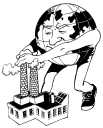
 1 Think about all the things you enjoy doing outside. Do you have a huge, green field or city park close to your house where you can play baseball or soccer? Do your parents take you swimming or camping during your summer vacation? Maybe you and your friends just like to hang out on your street and ride bikes or scooters.
2 Our world is so beautiful. It's part of the reason we love to be outdoors. The blue skies, clear lakes and rivers, rich soil, and fresh air are all valuable natural resources that make up a healthy, safe environment. Everyone living on the earth needs to do his or her part to help protect these resources so our world will still be healthy and beautiful many years from now.
3 As the population on earth continues to grow at a fast rate, it becomes harder to protect our land, air, and water from harmful pollution. The most important way people can fight pollution is to learn as much as possible about how their actions affect the environment. Then they can make wise choices that will reduce damage to the planet.
4 Governments, scientists, businesses and industries, agriculture, environmental organizations, and individuals can all help to control pollution. Pollution management, which specifically involves reducing and cleaning up pollution, is expected to be one of the fastest growing industries of the future.
5 The government serves a vital role in managing pollution by passing laws and setting guidelines to set and enforce pollution standards. In 1970, Congress passed the Clean Air Act, which limited the amount of air pollution that cars, utilities, and industries could release.
6 Scientists and engineers have helped by developing products and processes that are cleaner and safer for the environment. For example, they have developed devices that remove harmful particles from smokestack emissions at power plants.
7 Businesses are working towards finding safer ways to dispose of solid and chemical wastes. They are also reducing the amount of solid waste that ends up in the landfill by recycling such things as paper, plastic, bottles, and cans.
8 Farmers are developing ways to grow food that requires them to use fewer harmful fertilizers and pesticides. One way they do this is by rotating the crops they plant from year to year. They have found that some crops like corn and wheat drain the soil of an important natural chemical called nitrogen. But when the farmers plant alfalfa or soybeans, the nitrogen is restored in the soil. If they alternate the crops they plant every year, they don't need to use harmful chemical fertilizers to replace the nitrogen.
9 As individuals, there are also many things we can do to protect our environment. We can use less electricity by turning off lights and appliances when we're not using them. We can use less air conditioning in the summer and less heat in the winter. If the need for this energy is reduced, then the power plants will produce less electricity and release fewer harmful pollutants into the air.
10 Driving less is one of the best ways to save energy and avoid polluting the air. We can help by sharing rides to school or work. We can also purchase cars that use less fuel such as the new "hybrid" cars. (Read more about this in our article titled, "Hybrid Cars.")
11 People can buy products that are safe for the environment. For example, households can help reduce water pollution by using fewer toxic cleaning products and by properly disposing of any toxic products they do use. They can reduce the amount of solid waste by purchasing products that have the least amount of packaging to throw away.
12 One of the simplest ways individuals can prevent pollution is by reusing products. For example, some milk suppliers use glass bottles instead of paper cartons. The bottles may be refilled and used again. People can reuse old paper or plastic bags to carry groceries or to hold garbage.
13 Recycling is another way of reusing materials. Many cities and towns have recycling programs. Recycling saves energy and raw materials, and it prevents pollution. Metal cans, glass, paper, plastic containers, and old tires can all be recycled. Cans can be melted down and used to make new ones. Glass can be ground up and made into new containers or used as a substitute for sand in road pavement. Paper can be reprocessed into different paper products. Plastics can be melted down and re-formed into plastic lumber for such uses as fences, decks, benches, and carpeting. Old tires can be burned to produce energy. They can also be ground up and added to asphalt to make roads or such molded products as floor mats and playground equipment.
14 We can also help keep our streets and neighborhoods clean by making sure we throw away trash in its proper place. You may not think it's a big deal to toss a tiny candy wrapper on the ground, but what if everybody did the same thing? I think you can imagine what a mess that would be. Instead of adding to the problem, we can be part of the solution by picking up litter and putting it in a trashcan. We can encourage our friends and families to do the same thing.
Copyright © 2008 edHelper
Author:
Kara Stevenson
Last modified:
3/3/2009 8:14 AM (EST)


 Please wait...